What is Clawford?
Last updated: 2026-04-15 · Reading time: ~8 min · Difficulty: easy
TL;DR
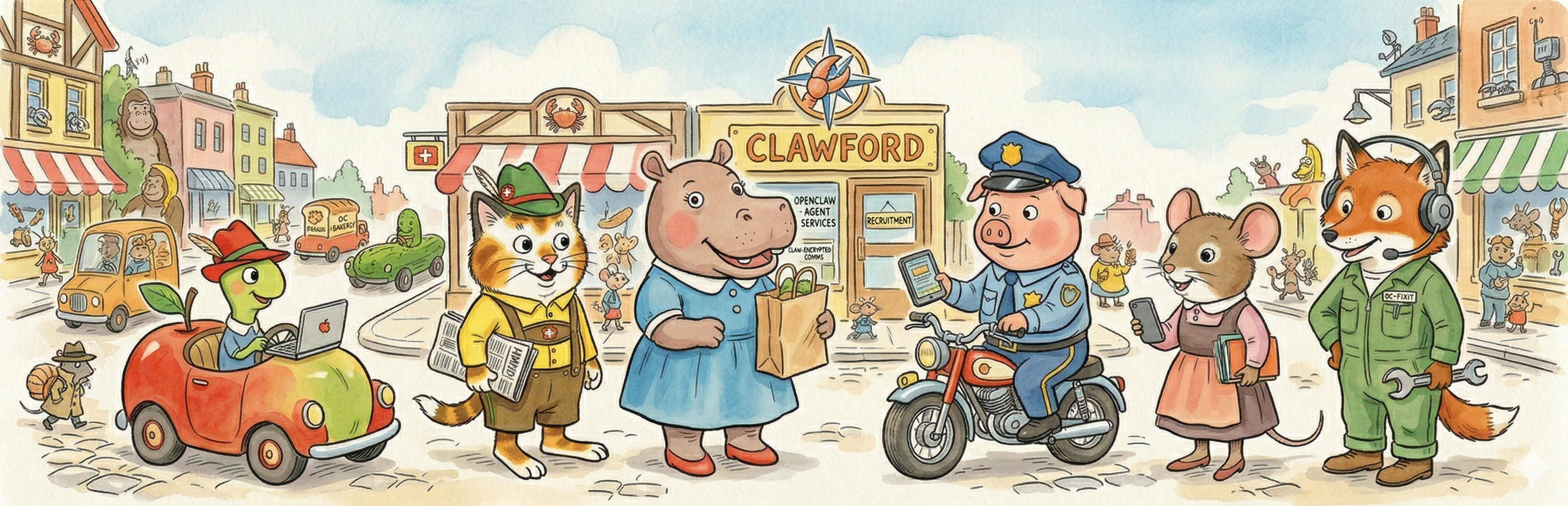
- Clawford is a personal fleet of LLM agents running on a cheap VPS. Each agent is a teleported Busytown character — yes, the Richard Scarry ones — and each has a narrow job.
- This guide is the scar-tissue version — what I'd tell a friend over beers, not a pitch deck. Most of it is written because something bit me first.
- It's aimed at people who want multiple agents sharing infrastructure, not one standalone bot.
- If you want the myth version before the manual version, read docs/ballad-of-mr-fixit.md first.
- Start with Ch 03 — Before you start when you're ready to move.
A fox named Mr Fixit
Every morning at 5am, a fox named Mr Fixit checks that the lights are still on in Clawford and sends me a one-line status to Telegram. If the news agent has stopped fetching headlines, Mr Fixit tells me. If a Dropbox sync has conflicted, Mr Fixit tells me. If everything is fine — which, astonishingly, it sometimes is — he says nothing at all, which I have come to recognize as its own kind of love language.
Clawford is what I call the thing that runs him, his five coworkers, and the small file-based shared memory they all write into. The animals themselves teleported in from Richard Scarry's Busytown — I borrowed them wholesale and put them to work here, for reasons that will not become clearer. It lives on a $30/month Hetzner box, stitched together with plain host crontab, codex, Dropbox, Telegram, some Python, and a great deal of hard-won regret.
What Clawford tries to do
I wanted software I could trust to do small, recurring, personal-life jobs while I slept:
- Curate the news I actually read (Lowly Worm 🐛📰).
- Reorder the things I keep running out of (Hilda Hippo 🦛🛒).
- Keep my family's calendar honest (Mistress Mouse 🐭📅).
- Prep me for meetings and debrief me after (Sergeant Murphy 🐷🔍).
- Remember who's who in my life, and when to follow up (Huckle Cat 🐱🤝).
- Watch the whole fleet so none of the above quietly die (Mr Fixit 🦊🔧).
Each agent has a narrow remit on purpose. They share a common brain — a directory of markdown files with schemas — so one agent can hand context to another without me playing messenger.
What Clawford does not try to do
It is not a general-purpose assistant. It does not replace humans, make autonomous financial decisions, post to family group chats on my behalf, or hold opinions I didn't authorize it to hold. When an agent is unsure, it asks me. When it's sure and wrong, it eventually finds out, and I have words with it in the form of a new entry in a MEMORY.md file.
The shape of the thing
          ┌─────────────────────────────────────────┐
          │          Telegram (you ↔ fleet)         │
          └───────────────────┬─────────────────────┘
                              │ 6 per-agent bots + 1 direct bot
                              │
    ┌────────┬───────┬────────┼────────┬────────┬────────┐
    │Fix-It  │Lowly  │ Hilda  │ Mouse  │ Murphy │ Huckle │  ← Python agents:
    │ 🦊🔧   │ 🐛📰  │  🦛🛒  │  🐭📅  │  🐷🔍  │  🐱🤝  │    SOUL · IDENTITY
    │        │ Worm  │  Hippo │        │        │  Cat   │    · TOOLS · crons
    └────┬───┴───┬───┴───┬────┴───┬────┴───┬────┴───┬────┘
         │       │       │        │        │        │
         └───────┴───────┴────┬───┴────────┴────────┘
                              │
                    ┌─────────┴─────────┐        ┌──────────────┐
                    │   host crontab    │        │    codex     │
                    │ (every schedule   │        │  (LLM calls  │
                    │  fires from here) │        │  via ChatGPT │
                    └───────────────────┘        │  Plus)       │
                              │                  └──────┬───────┘
                              │                         │
                              └───────────┬─────────────┘
                                          │
                                  ┌───────┴───────┐
                                  │  Shared brain │   ← Dropbox-synced
                                  │ (facts, people,│    markdown with
                                  │  tasks, notes) │    schemas
                                  └───────────────┘
The shape is deliberately flat. Agent scripts are plain Python invoked from system crontab. LLM reasoning — ranking, composing, judgment calls — happens via agents.shared.llm.infer(), which wraps the codex CLI and rides a ChatGPT Plus subscription for every call. Deterministic work — scrapers, browser automation, fleet-health probes — runs as plain Python. There is no container runtime, no gateway service, no LLM cron scheduler with a 600-second ceiling. Ch 07 — Intro to agents draws the LLM-vs-deterministic line more carefully; Ch 02 — What Isn't Clawford? explains why the shape looks like this and not like the platform Clawford grew out of.
VPS or Mac mini?
I went with a VPS for four reasons, none of them religious:
- Always-on without kicking a family laptop. A Mac mini under the TV works until someone unplugs it to dust.
- Blast radius. If an agent goes feral, I'd rather that happened on rented hardware than on the box with my tax returns on it.
- Clean rebuild. The whole fleet is Terraform-provisioned and configuration-managed, so "try again from scratch" is a 40-minute thing, not a weekend.
- Not my residential IP. For most services this is a feature; for Amazon and Costco it is the exact opposite, which is how I ended up with strong opinions about residential proxies (Ch 04).
A Mac mini is probably fine if your fleet is smaller, you already own the hardware, and you don't mind the first three points. I don't claim one path is right.
Who this guide is for
- You're comfortable driving SSH, git, shell, and Python with Claude Code or Codex as a copilot. You don't need to be an expert in any of it — you need to be able to wield the tools well enough to unstick yourself when the LLM runs out of ideas.
- You want to run multiple agents sharing infrastructure. The whole guide is written around that case.
- You're OK with "works on my box" as a starting point and willing to carry some operational weight yourself.
Who it isn't for
- You just want one bot. If all you need is a single agent to do one thing, Busytown is massive overkill. Clone a smaller scaffold.
- You want a turnkey product. This is a field guide, not a product. There are places in it where the answer is "I gave up and wrote a memory file."
- You need a security-reviewed system. I'm not a security expert. I'll tell you what I do and what I know I don't do (Ch 19), but audited it is not.
If you read nothing else — quickstart
- Sign up for a Hetzner Cloud account and a Dropbox account you're willing to dedicate to this.
- Create a Telegram account and start a chat with @BotFather — you'll make bots there.
- Clone the repo and read Ch 03 — Before you start end-to-end before you provision anything.
- Follow Ch 04 — VPS setup to stand up a locked-down box.
- Walk Ch 06 — Infra setup to wire up the shared library, the shared brain, host crons, and the Dropbox daemon.
- Deploy Mr Fixit first, following Ch 09. He's the training-wheels agent and the canary for everyone after him.
- Wait for your first 5am status message. When it arrives, pour yourself something, and then pick your second agent from Ch 07.
Caveat emptor
I'm writing this as I learn. Half of it is scar tissue from mistakes, and some of it will be wrong by the time you read it — services change their HTML, APIs deprecate, cookies mutate, and every so often I do something clever with a shell script at midnight that I regret by breakfast. Where I can, I've tried to tell you why a thing is the way it is, so that when it stops being that way you'll have enough context to adapt. Where I can't, I've just told you what bit me and left it at that.
If you find something here that's wrong, assume I'd like to know.
See also
- index.md — the full table of contents for this guide.
- Ch 02 — What Isn't Clawford? — the decision doc that explains why the runtime looks like this and not like the platform it used to sit on top of.
- docs/ballad-of-mr-fixit.md — a five-act tragedy covering just the first day of setup. A lot more has gone wrong since; the ballad is the overture, not the opera. Read it when you want the lore instead of the manual.
- README.md — the shorter elevator pitch.
- AGENTS-PATTERN.md — the shape of an agent in one file; useful as a cheat sheet once you start Ch 07.